In Home Nursing vs Nursing Facility Outcomes Children
This article is educational and should be reviewed with the child’s pediatrician and care team.
Choosing where a medically fragile child receives care can affect more than daily logistics. Families often weigh clinical safety alongside familiar routines, caregiver participation, school and therapy access, and the emotional experience of the child and family.
When comparing in home nursing vs nursing facility outcomes children, there is no single setting that fits every family. In-home skilled nursing may help a child remain connected to familiar caregivers and routines while receiving support for complex needs. But the appropriate plan depends on acuity, staffing, caregiver capacity, and the authorized plan of care.
For Georgia families using or exploring Georgia Medicaid, GAPP may support medically necessary nursing or personal care in the home when eligibility, documentation, and authorization requirements are met. Start by understanding why facility-based care may be considered, then compare the clinical and family factors that shape a safe, individualized decision.
Talk with Greater Living Home Care about your child’s care needs at (912) 446-5838.
Why Do Some Families Consider Nursing Facility Placement?
Considering facility-based care is not a sign that a family has failed or that a facility is automatically the wrong setting. Families may reach this decision when a child’s medical needs, equipment, staffing situation, or daily care demands exceed what the home can safely sustain. A nursing facility may also be part of a temporary plan during recovery, rehabilitation, or a period when the family is arranging a more reliable long-term care structure.
A child’s acuity is one important factor. Tracheostomy care, ventilator support, oxygen monitoring, frequent suctioning, feeding-tube management, aspiration risk, seizure monitoring, and complex medication schedules may require trained staff and dependable coverage. The question is not simply whether a task can be performed at home. It is whether the right clinician can be present when needed, whether equipment is maintained, and whether an emergency response plan is realistic for that child and family.
Staffing can make the difference between a workable home plan and an unsustainable one. Home-health workforce shortages may leave families covering nursing responsibilities themselves, which can affect employment, health, and overall well-being. Research has also noted that inadequate home health may be associated with longer hospital stays, readmissions. Care errors, or institutional placement, although those findings do not predict what will happen to any individual child: the cited Medicaid utilization study.
Families often weigh several practical questions:
- Can qualified nurses cover the hours the child’s authorized plan requires?
- Who will manage medications, devices, feeding, and changes in symptoms overnight?
- Can caregivers participate without becoming the only backup for missed shifts?
- Is there a clear plan for urgent changes, equipment failure, or transport?
- Would the arrangement be temporary, or does the family need a longer-term setting?
These decisions deserve individualized clinical discussion. Some children may receive appropriate support at home with skilled nursing, equipment, trained caregivers, and coordinated oversight. Others may need facility-based care for a period or on an ongoing basis. The safest choice depends on the child’s acuity, available supports, caregiver capacity, and care plan, not on a universal rule about one setting being better than the other.
What Does Research Say About In-Home Nursing vs Nursing Facility Outcomes for Children?
Research can inform a care-setting discussion, but it cannot make the decision for a particular child. One important study examined children discharged from the hospital with home health nursing and compared them with similar children who did not receive home health after discharge. The retrospective, matched cohort included 2,783 children receiving postdischarge home health and 7,361 matched controls. Researchers measured readmissions, hospital admissions, hospital days, and hospital-care costs during the following 12 months. Read the study abstract on PubMed.
The home-health group had somewhat greater levels of complex chronic conditions, technology assistance, and neurologic impairment than the matched control group. Even with those differences, the study reported lower hospital use among children who received home health nursing. The results are useful evidence, but they should be interpreted as an association. Not as proof that in-home nursing is better than every nursing facility or that it guarantees a better outcome for an individual child.
| Measure | Home health | Controls |
|---|---|---|
| 30-day readmission rate | 18.3% | 21.5% |
| Average admissions | 0.8 | 1.0 |
| Average hospital days | 6.4 | 6.6 |
These findings do not directly compare home nursing with a specific nursing facility. Instead, they compare postdischarge home health with matched children who were not discharged to home health.
Clinical acuity, family capacity, staffing reliability, equipment, and discharge planning can influence the setting and the outcome. The authors also called for further investigation into how home health affects children’s health and use of health services.
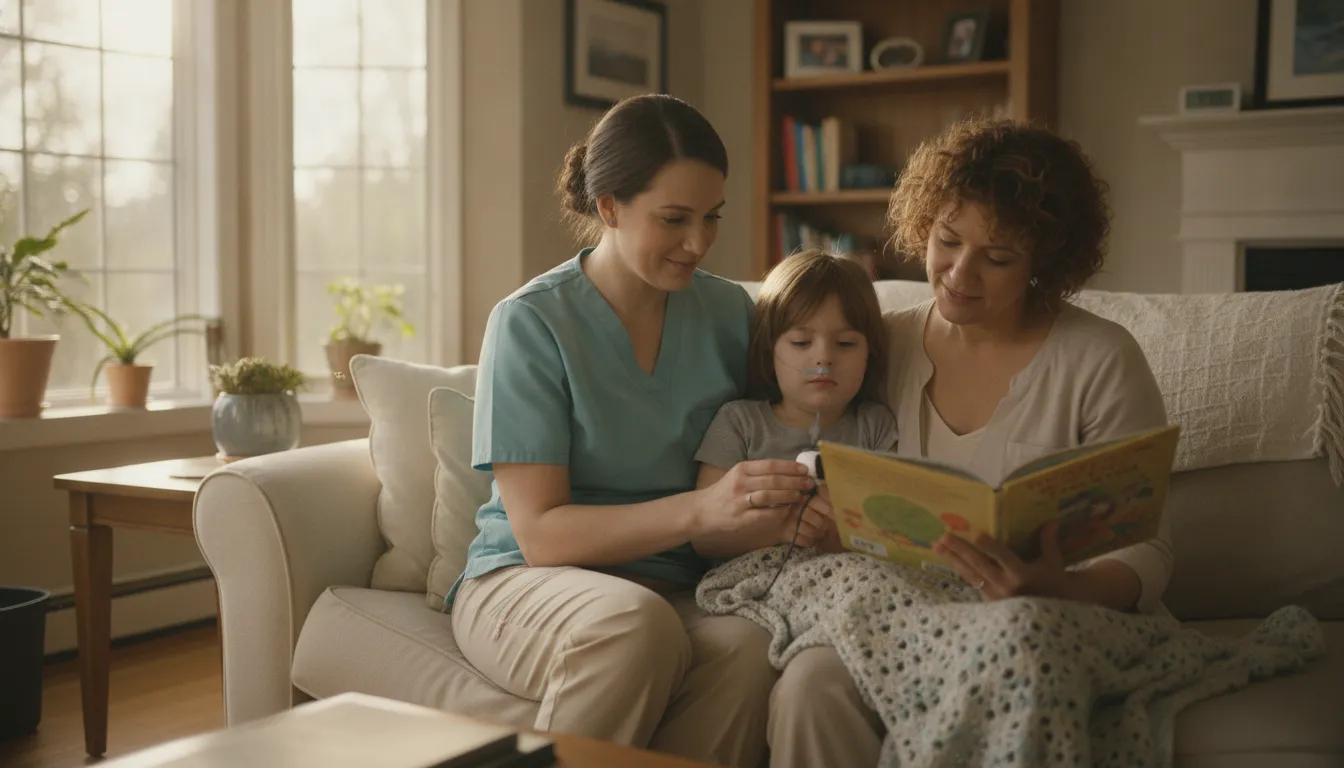
A separate analysis of Medicaid data reinforces why the details of a child’s needs matter. It found that home health care includes a broad range of services, from intermittent nursing visits to repeated daily care for children using complex medical technology. The study also described home health as supporting direct care, parent caregivers, and care coordination. Its findings do not establish that one setting is universally appropriate. But they support an individualized review of safety, medical necessity, caregiver support, and the authorized plan of care. Review the Medicaid utilization study on PMC.
How Can Home Care Support Emotional and Developmental Needs?
Clinical care is only one part of a child’s daily life. When skilled nursing is delivered at home, the care plan may fit around familiar routines, relationships, and activities.
A child may be able to remain connected with parents, siblings, school, therapies, faith communities, and other meaningful parts of life. This depends on the child’s medical needs and authorized plan.
This does not mean home care produces the same experience or outcome for every child. Emotional and developmental needs differ by age, communication style, diagnosis, medical equipment, fatigue, and family circumstances. A thoughtful plan focuses on what helps this particular child participate safely and comfortably. Nurses can follow established communication cues, support prescribed treatments, and coordinate observations with parents and the child’s broader care team. That continuity may make it easier for caregivers to notice changes and share useful information with clinicians.
Protecting routines and relationships
Care at home can help families organize nursing tasks around sleep, meals, schoolwork, therapy appointments, play, and time with siblings. For a child who uses oxygen, a feeding tube, suctioning, seizure monitoring, or other complex support. The team can carry out authorized clinical responsibilities while the family maintains its role in everyday life. School participation or community activities may remain possible when they are medically appropriate and supported by a safe plan. Home nursing does not replace school-based services, therapies, emergency care, or clinical direction. It can help coordinate daily care with those supports.
Considering the caregiver experience
Family well-being also belongs in the decision. A 2024 mixed-methods study included children with medical complexity, family caregivers, and physicians, and used interviews to examine gaps in complex pediatric care. Its focus reflects why caregiver emotional well-being matters when families compare care settings, although it does not prove that home nursing creates a universal emotional benefit. The study is available in research on pediatric complex healthcare and home nursing.
Before choosing a setting, families can ask:
- Which routines, people, and activities help my child feel secure and engaged?
- How will nursing care fit with school, therapies, sleep, meals, and sibling time?
- How does my child communicate comfort, distress, pain, or fatigue?
- What support would make caregiving sustainable for our household?
- How will the team document changes and communicate with the child’s clinicians?
What Does GAPP Enable That Facility Care Cannot?
For some Georgia families, the Georgia Pediatric Program (GAPP) can make medically necessary support possible in a child’s familiar home environment. That does not mean home care is the right setting for every child, or that GAPP approval is automatic. The appropriate plan depends on the child’s condition, safety needs, family supports, and clinical recommendations.
GAPP serves eligible Georgia Medicaid members under age 20 years and 11 months who require medically necessary nursing and/or personal care support. Eligibility generally involves Georgia residency, Medicaid enrollment, a qualifying physical disability or medically fragile condition, and documentation that supports the requested care. Prior authorization and medical-necessity review are part of the process. The Georgia Department of Community Health oversees the program, Alliant Health Solutions reviews authorization, and DFCS verifies Medicaid eligibility.
When authorized, in-home support can connect clinical care with the child’s everyday routines. An individualized Model of Care can account for the child’s equipment, medications, daily schedule, communication needs, family participation, and emergency planning. Greater Living Home Care’s clinical team includes RNs, LPNs, CNAs, and PCAs. RNs coordinate care and provide clinical oversight rather than simply matching a family with an independent caregiver.
What High-Acuity Care Can Be Provided at Home?
Depending on the authorized plan and each clinician’s scope, examples of pediatric skilled nursing tasks may include the following:
- Tracheostomy care, suctioning, and ventilator support or troubleshooting.
- Oxygen monitoring and assessment of changing respiratory needs.
- G-tube feeding, pump management, and medication administration.
- Wound care and seizure monitoring.
This coordinated model may help parents participate in care. It may also help the child stay connected to siblings, school, therapies, and community routines.
It does not eliminate clinical risk or replace hospital, rehabilitation, or facility services when those are needed.
Families can learn more about Georgia Pediatric Program GAPP services. They can also review Georgia Medicaid in-home nursing coverage. Documentation and authorization factors shape each individual plan.
How Should Families Compare the Two Care Settings?
A thoughtful comparison starts with the child’s current needs, the family’s daily reality, and the safeguards each setting can provide. Use the questions below with the child’s physician, care team, and authorized program representatives. The goal is not to label one setting as best for every child, but to identify the plan that can be delivered safely and consistently.
- Match the setting to clinical acuity and safety needs. List the care your child needs each day and during an emergency, such as tracheostomy care. Suctioning, ventilator support, oxygen monitoring, G-tube feeding, medication administration, wound care, or seizure monitoring. Ask whether the setting has the equipment, emergency procedures, and trained staff required for those needs. A child whose condition changes frequently may need a more intensive plan or regular clinical review.
- Examine staffing and RN supervision. Ask who provides direct care, who responds when a nurse is unavailable, and who reviews the plan. A private-duty pediatric agency may coordinate RNs, LPNs, CNAs, and PCAs around an individualized plan. Learn how supervisory nurses communicate with the family, document care, review adherence, and respond to changes. For a clearer explanation of responsibilities, read about pediatric home-health nursing roles.
- Consider continuity and the child’s development. Compare how each setting would support sleep, school, therapies, sibling relationships, and familiar routines. Consistent caregivers may help the child communicate preferences and participate in daily activities. Ask how handoffs are managed and how the team will preserve routines while still adapting to medical changes. These benefits are possible, not guaranteed, and should be weighed against the child’s specific condition.
- Measure caregiver capacity honestly. Identify which tasks family members can safely perform, which require skilled nursing, and what happens overnight or when a caregiver is ill or working. Home care can support parents through direct care and coordination, but staffing shortages or inconsistent coverage can shift too much responsibility back to the family. A sustainable plan must protect both the child’s safety and caregiver well-being.
- Confirm authorization, documentation, and reassessment. For families exploring GAPP, eligibility depends on Georgia Medicaid, medical necessity, supporting documentation, and authorization. Ask the care team what records and physician orders are needed, which services are authorized, and how changes will be reported. The pediatric home nursing referral process can help families understand the steps after a provider recommends care. Reassess the plan whenever the child’s condition, equipment, schedule, or caregiver support changes.
Talk with Greater Living Home Care about your child’s care needs, or call (912) 446-5838.
Frequently Asked Questions
Is in-home nursing always better than nursing facility care for a medically fragile child?
No. The safest and most appropriate setting depends on the child’s acuity, equipment, clinical needs, caregiver capacity, available staffing, and authorized plan of care. In-home nursing may support familiar routines and family participation, while facility care may be appropriate when needs or available supports cannot be safely managed at home.
What outcomes should families compare between home nursing and facility care?
Look beyond hospital use. Compare medication and respiratory safety, continuity of clinical oversight, sleep and daily routines, school and therapy participation. Family involvement, social connection, caregiver strain, and how quickly the team can respond when the child’s condition changes. Ask each care team to explain risks, benefits, and measurable goals for your child.
Can Georgia Medicaid GAPP help a child receive nursing care at home?
GAPP may support eligible Georgia Medicaid members under age 20 years and 11 months who require medically necessary nursing or personal care. Services are delivered at home, but eligibility, documentation, medical necessity, service hours, and authorization determine what care is approved. The Georgia Department of Community Health oversees the program, while Alliant reviews prior authorization and DFCS verifies Medicaid eligibility.
What skilled care can a pediatric home nurse provide?
Depending on the child’s authorized plan and clinical needs, pediatric skilled nursing may include tracheostomy care. Suctioning, ventilator support, oxygen monitoring, G-tube feeding, medication administration, wound care, and seizure monitoring. A nursing team should build an individualized plan with the family and coordinate care rather than simply match a family with an independent caregiver.
Ready to Discuss Your Child’s Nursing Needs?
Choosing a care setting can feel complex when your child has significant medical needs. A conversation with a pediatric skilled nursing team may help you understand practical options and identify appropriate Georgia Medicaid or GAPP next steps. Contact Greater Living Home Care to discuss your child’s needs, or call (912) 446-5838.
