
Decatur, Georgia Family Care Guide: Pediatric Home Nursing and GAPP Support

For families researching pediatric home nursing Decatur Georgia GAPP support, a clear picture of an ordinary day can make a first conversation more useful. Start with what happens, what instructions guide care, and what still needs confirmation. The Georgia pediatric home health guide offers broader program context.
Discuss your child’s home nursing needs with our team
What should Decatur families know about pediatric home nursing and GAPP?
GAPP is a Georgia Medicaid program for eligible medically fragile children under age 21. Program rules, clinical review, and authorization determine whether services apply to an individual child. A diagnosis alone does not establish eligibility, and a family’s preferred schedule does not establish approved hours.
Greater Living Home Care provides in-home pediatric skilled nursing in Georgia. Depending on a child’s assessed needs and plan, care may address complex needs such as tracheostomy care, ventilator support, oxygen use, and feeding tubes. A provider conversation can explain services and next steps, but it cannot promise a program decision.
For official context, consult the Georgia Pediatric Program information. It describes GAPP’s scope; confirm current requirements and individual decisions with the appropriate Georgia Medicaid or GAPP representative.
How can you describe pediatric home nursing Decatur Georgia GAPP support needs?
You do not need to present a polished clinical report. Your goal is to describe what happens, when support matters, what instructions already guide the family, and what questions remain. Separate direct observations from information a clinician or program representative has provided.
Make a day map using broad blocks rather than recording every minute. Include waking, school, meals, appointments, rest, and overnight routines. For each recurring care task, note the approximate time, who currently performs it, and whether it follows written instructions. For example, a caregiver could note that tube feeding occurs at specified points in the day, that equipment is used as directed, and that a clinician has supplied written guidance. Do not add a new clinical interpretation to make the notes sound more formal.
- Routine tasks: Record recurring activities and approximate timing.
- Skilled care: Describe clinical tasks using the child’s current instructions, not a guess about what a service should include.
- Changes or concerns: Note what caregivers observed and whom they contacted under the existing plan.
- Household schedule: Include school, appointments, sleep, and caregiver availability as context, not as a promise of coverage.
- Open questions: Mark what needs confirmation instead of filling gaps from memory.
A short example shows the difference between observation and conclusion. “During the afternoon routine, we follow the current written instructions for equipment care” describes an event. “This means we need a nurse for four hours each day” jumps to a service and schedule conclusion. Keep the first type of detail in your notes and ask the appropriate clinical or program contact about the second.
If an instruction is unclear or two documents appear to differ, ask the treating clinician which direction currently applies. Do not decide between conflicting clinical instructions yourself. That keeps the discussion grounded in current guidance rather than a household’s understandable but uncertain interpretation.
Which records and details may help with a GAPP discussion?
Gather what you already have; you do not need a perfect binder to ask an initial question. Current, legible records can help the family and care team see what is known, what may be outdated, and what still needs to be requested.
- Georgia Medicaid information and GAPP notices or correspondence, if applicable.
- Recent clinical summaries, discharge documents, and current care instructions.
- A current medication and equipment list, where relevant to the child’s routine.
- School, therapy, and appointment schedules that affect an ordinary week.
- A dated, concise record of routines, changes, and questions.
- Names and contact details for clinicians or program representatives already involved.
- Any forms or records a program contact has specifically requested.
Before sharing, check the dates and make sure the pages are readable. If discharge paperwork differs from a later instruction, ask the clinician which applies; do not select one based on preference. Ask the program contact which documents are needed, whether a particular form or format is required, and how to submit it. Use an approved secure channel for private health information rather than an informal message.
A simple folder can have four sections: coverage and notices, clinical instructions, daily routine notes, and questions or follow-up. Put dates on new notes, keep originals where possible, and mark older instructions as superseded only when a clinician or responsible contact confirms that change. When a request comes in, write down who will obtain the item and when you will check whether it was received.
It can help to make a one-page document list. For each item, record the document name, date, where it came from, and whether it has been shared. For instance, “care instructions, updated in March, from treating clinician, not yet submitted” is more actionable than “medical paperwork missing.” Keep sensitive information private and send only what the receiving party requests.
How does a Model of Care plan connect home routines and clinical guidance?
A Model of Care plan brings assessed needs and planned services into a coherent approach. It can clarify which tasks are part of the plan, who is responsible, what instructions apply, and how information should move between family and care team. It should reflect the child’s circumstances rather than a generic checklist.
Greater Living’s clinical staff develops individualized plans and provides clinical oversight. Ask who develops and reviews the plan, how revisions are recorded, and whom the family should notify when needs or instructions change. Families can read more about the GAPP Model of Care plan and the Georgia Pediatric Program services.
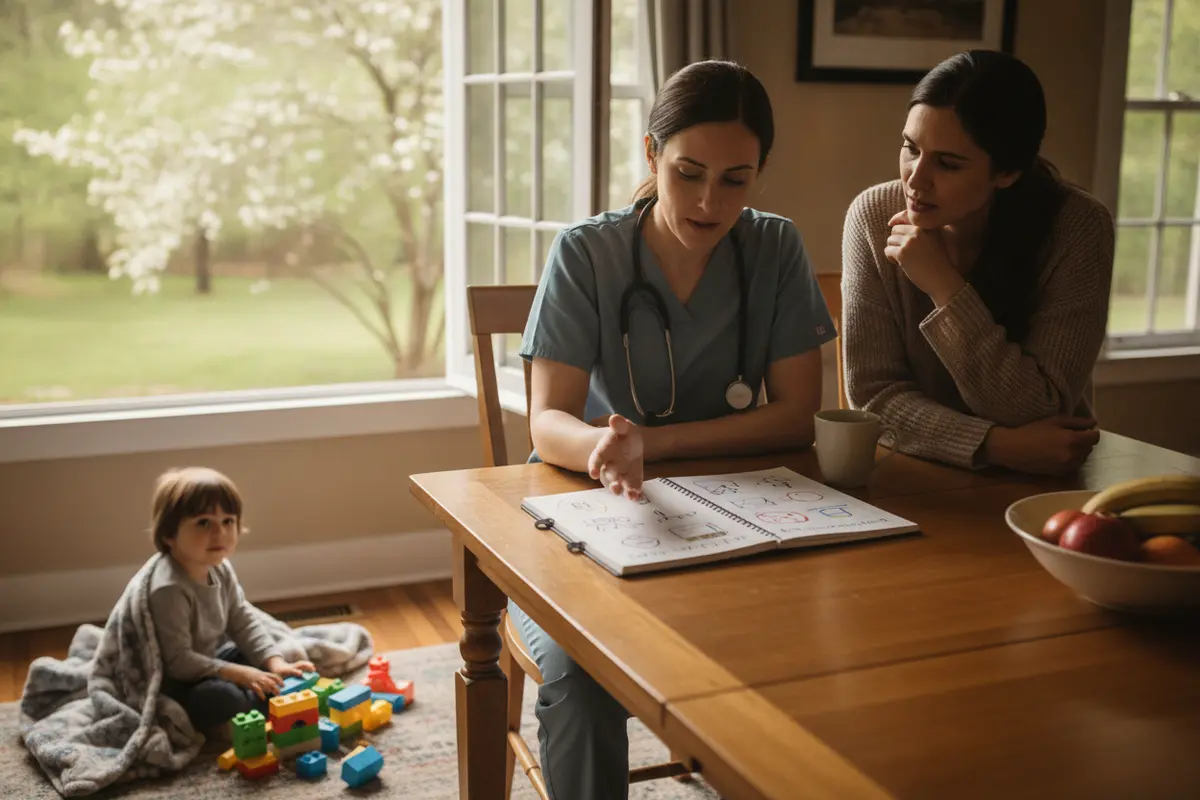
One practical review is to compare the written plan with a typical day. Ask whether it reflects current instructions, whether recurring tasks are described clearly, whether the family knows the right contact for questions, and whether changes and next steps are documented. If something changed since the plan was prepared, identify the difference and ask how the record should be updated. Do not assume an older version still applies.
Consider a simple “plan versus routine” check. Make two columns: the plan’s description and what the family currently observes. If they align, note that the routine is consistent. If they differ, write a neutral question such as “The schedule has changed since this plan was prepared; who should review it?” This approach highlights a possible update without claiming that a particular service or number of hours must follow.
What questions should families ask about nursing roles and scheduling?
Ask how the child’s needs relate to the roles involved in care. Registered nurses, licensed practical nurses, and personal care support workers do not have interchangeable responsibilities. The appropriate role depends on the child’s needs, clinical direction, and program requirements. Clarify clinical oversight and care coordination rather than discussing a schedule alone.
| Topic | Question to ask | What to clarify |
|---|---|---|
| Care tasks | Which tasks are included in the current plan? | Who performs each task and which instructions apply. |
| Clinical oversight | Who coordinates the plan and reviews changes? | How concerns reach the clinical team and how updates are documented. |
| Schedule | What schedule is being discussed or authorized? | How household preferences differ from authorized services. |
| Coverage change | What should we do if a scheduled nurse cannot attend? | Who will notify the family and explain the next steps. |
| Records | Which documents remain outstanding? | Who requests, submits, or follows up on each item. |
| Communication | Who is the right contact for different questions? | How to distinguish clinical questions from program or administrative questions. |
Write the answer, the person responsible for the next step, and any expected date. Then repeat the plan in plain language: “I will send the current care instructions; you will tell me whether anything else is needed.” This brief check can reveal a misunderstanding while there is still time to correct it.
Families can also consult common home care and GAPP questions and learn about pediatric private duty nursing. Use these resources to frame questions, not to assume that an example applies to a particular child.
How can you prepare for a first provider conversation?
A first conversation is not an eligibility decision. It is a chance to explain the situation, learn what the provider can discuss, and identify a useful next action. Choose one main question and keep the most relevant notes nearby.
- Open with the question. For example: “Can you help us understand whether our child’s documented needs may fit GAPP home nursing?”
- Describe a typical day. Explain recurring care, equipment, and times when needs change, using current instructions.
- Separate confirmed details from unknowns. Identify Medicaid or GAPP notices you have, records that are missing, and questions for a clinician.
- Ask about the process. Find out what records the next conversation requires, who reviews them, and how to submit them securely.
- End with assigned actions. Record who will do what, how follow-up will happen, and when it is reasonable to check back.
Greater Living serves families across Georgia, including Decatur. Services and program decisions depend on individual circumstances and review. While preparing, explore an overview of GAPP and the GAPP application checklist.
Consider a caregiver whose child uses a feeding tube. The caregiver might bring the current written instructions, note when feeding support occurs, and list questions about who reviews the documentation. The caregiver should not infer that the equipment guarantees eligibility or a particular number of hours. A useful result of the conversation is a clear list of what the family needs to verify next.
Another family may have Medicaid information but no recent care summary. Rather than delaying every question until a complete file is assembled, they can explain what is on hand and ask which record to request first. The key is to avoid presenting an incomplete file as complete and to assign a next step to a specific person.
How can Decatur families keep care coordination clear over time?
Needs, schedules, and clinical instructions can change. Keep dated copies of important information, note when an instruction is updated, and notify the appropriate care contacts according to the current plan. When a concern arises, record what happened, when it happened, and what action the family took under existing guidance. A concise factual note is more useful than relying on memory weeks later.
A weekly five-minute review can keep follow-up manageable. Check whether appointments, school routines, or equipment instructions changed; whether a document is current; and whether someone owes the family a response. Add only the follow-up needed. If nothing changed, retain the dated note without creating extra paperwork. If needs changed, ask the clinician and program contact how the plan or review process should respond.
For a handoff between caregivers, use a short note that identifies the current plan version, relevant routine changes, and the contact to use for questions. Do not use it to introduce a new care step or replace clinician directions. Keep the note private and share it only through approved channels. If a caregiver is unsure whether a direction is current, pause and ask the designated contact rather than passing along an assumption.
When a question is administrative, keep a record of the date, contact, question, and answer. If there is no response by the expected date, follow up with the same concise summary and ask whether another person should handle it. When a question is clinical, route it to the clinician or care-team contact specified in the current plan. For a change in the child’s condition, follow the clinician’s directions and emergency plan.
This article cannot replace medical advice or determine GAPP eligibility, coverage, or authorization. Confirm program-specific questions with Georgia Medicaid or the appropriate GAPP representative. For further planning, see the family guide to GAPP prior authorization and GAPP nursing continuity of care.
Contact Greater Living to discuss a next step
Frequently Asked Questions
Does living in Decatur automatically qualify a child for GAPP?
No. Location does not establish eligibility. A child must meet applicable Georgia Medicaid and GAPP requirements, and decisions depend on review of individual circumstances.
Does a particular diagnosis guarantee nursing hours?
No. A diagnosis alone does not guarantee eligibility, a specific service, or a schedule. Clinical documentation and program authorization determine what may be provided.
What should I bring to a home nursing conversation?
Bring available Medicaid and GAPP correspondence, current clinical summaries and care instructions, and a short description of daily routines and questions. Ask what else is needed and how to submit it securely.
Can a home care provider decide what GAPP will approve?
No. A provider can explain its services and help organize care discussions, but eligibility and authorization are determined through the applicable Georgia Medicaid and GAPP processes.
A clear account of daily needs, current instructions, and unanswered questions can make your next conversation more focused and useful.
