
A Practical Guide to Home Safety Medically Fragile Child Nursing Georgia

Home safety medically fragile child nursing Georgia planning works best as a shared process: identify the child’s everyday needs, review the home environment with the care team, and make clear plans for communication and urgent situations. Start with your child’s clinicians and, when relevant, a pediatric home nursing provider; a guide to what medically fragile can mean for Georgia families can help you prepare questions.
Talk with Greater Living Home Care about your child’s needs
What Does Home Safety Medically Fragile Child Nursing Georgia Planning Include?
Home safety is more than checking whether a room looks tidy. A family may need to think about the child’s daily routines, the safe use and placement of prescribed equipment, who can provide specific care, and how information reaches the right people. The details depend on the child’s condition and clinician-directed plan. A general checklist can organize the conversation, but it cannot replace medical instructions or an individualized assessment.
For children receiving skilled care at home, the family and clinical team can clarify which tasks require a licensed nurse, which actions caregivers have been taught to perform, and when to contact the child’s clinician or emergency services. Greater Living Home Care provides in-home pediatric skilled nursing through Georgia’s Pediatric Program (GAPP) for eligible children; the program and an individual child’s authorization determine what services may be provided. Read the agency’s overview of Georgia Pediatric Program home care services for context.
How Can You Review the Home Without Guessing at Medical Needs?
Walk through the home as the child experiences it during a typical day. Include the places where care happens, where equipment is used or stored, and the routes the child and caregiver use to move between rooms. Rather than trying to diagnose risks on your own, write down what you notice and ask the child’s nurse or clinician which concerns matter for that child.
- Care areas: Is there a clear, usable place for the care activities in the child’s current plan? Ask the care team how to arrange supplies and equipment safely.
- Movement routes: Are commonly used paths reasonably clear for the child’s mobility needs and any mobility aids? Ask the clinician or therapist about individualized transfer or positioning guidance.
- Supplies: Can caregivers find the supplies they need without confusing them with other household items? Confirm storage instructions with the prescribing clinician or supplier.
- Household access: Do the adults who provide care know where the written care instructions and emergency contact information are kept?
- Changing routines: Could school schedules, another caregiver, or a change in the home affect how care is carried out? Tell the clinical team when a change could affect the established plan.
Keep the review practical. A parent might note that an equipment area is also used as a walkway, or that two caregivers have different copies of a care instruction. Those observations make useful questions for the care team. Do not move, disconnect, adjust, or stop using prescribed equipment based on a general checklist; ask the responsible clinician or supplier for directions specific to the child.
It can help to do the walkthrough at more than one point in the day. A space may be clear in the morning but crowded when school bags, laundry, or delivery boxes arrive. Notice where a caregiver sets down supplies, where the child rests during a routine, and whether another household activity overlaps with care. Record the situation in neutral terms—such as “the hallway is narrow when the mobility aid is parked”—instead of deciding on a medical fix yourself. Bring the observation to the professional who can advise on the child’s needs.
Separate immediate concerns from improvements that can be discussed during a routine care conversation. If you believe there is an urgent danger, follow the child’s emergency instructions and seek appropriate help. For a non-urgent concern, note when and where it occurs, who is present, and what question you want answered. A specific observation is easier for the team to assess than a broad request to make the home “safer.”
Which Home Safety Questions Should You Ask About Equipment and Care Routines?
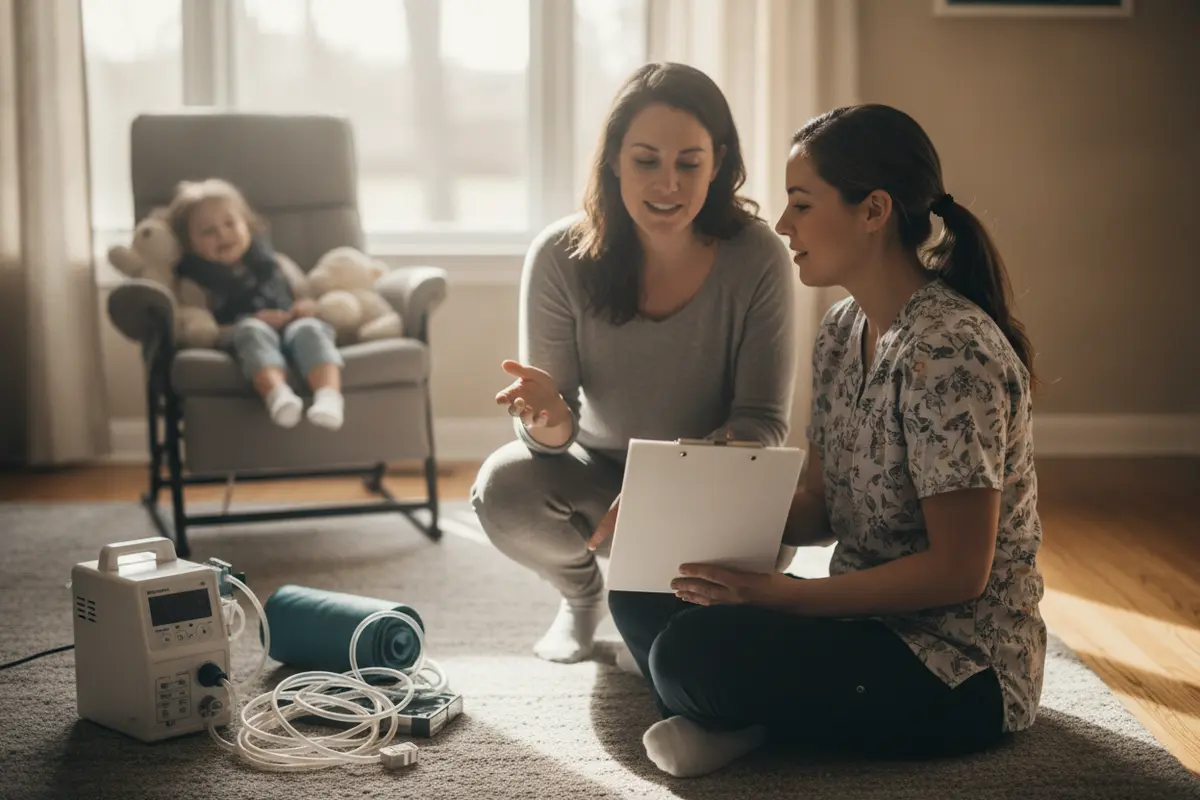
Children’s needs differ, so a device or care routine that is appropriate for one child may not fit another child’s plan. If the child uses respiratory equipment, a feeding tube, oxygen, mobility aids, or other medical supplies, ask the clinician responsible for that care to explain the instructions and who to call with questions. Nursing support can help families follow an authorized plan, but the provider should not substitute general guidance for orders from the child’s clinician.
Useful questions can include:
- Which parts of the child’s current plan require a nurse, and which tasks may a trained family caregiver perform?
- Who teaches a new caregiver the child-specific procedure, and how can that caregiver confirm they understand it?
- What should we do if equipment alarms, supplies run low, or something does not work as expected?
- Which changes should we report to the nurse, clinician, equipment supplier, or another member of the care team?
- Where should written instructions be kept so the people involved in care can find the current version?
Turn the answers into a practical reference that reflects the approved plan. For example, make a list of the right contact for clinical questions, equipment concerns, and supply requests. Include when each contact should be reached and what information they may need. Do not add procedures or thresholds from memory. If a new nurse, family member, or respite caregiver joins the routine, ask who will explain the child-specific instructions and how the caregiver can ask follow-up questions before taking on a task.
For families preparing to discuss equipment needs with a home nurse, this guide to preparing for a pediatric home nurse offers a starting point for organizing the home and the conversation. If the child has a specific device or procedure, ask the clinician for the appropriate instructions rather than using a general article as a substitute.
How Can You Make a Clear Plan for Caregivers and Urgent Situations?
A written communication plan helps family members and care professionals share consistent information. Agree on where the current care plan is kept, who updates it, and how caregivers can reach the appropriate clinical contact. Include the child’s clinician-approved instructions for urgent situations, along with emergency contacts. For an immediate emergency, follow the child’s emergency instructions and contact emergency services as appropriate.
Families can ask the care team to clarify:
- Who does what: Which responsibilities belong to the family, the nurse, the prescribing clinician, or another professional?
- How updates travel: How should a caregiver communicate a change, concern, or missed care task to the appropriate person?
- Which instructions are current: How will everyone recognize the latest clinician-approved plan and avoid relying on outdated notes?
- What to do when a regular caregiver is absent: Which qualified backup options can the family discuss with its care team or provider?
- When to seek help: Which symptoms or events require contacting the child’s clinician, and what should caregivers do in an emergency?
A useful handoff can be brief and consistent. The outgoing caregiver can share which routine tasks were completed, whether an expected supply is running low, and whether a concern needs follow-up, using the family’s approved communication process. The incoming caregiver can confirm where to find the current plan and who to contact if something is unclear. This is not a substitute for a clinical record or required documentation; it is a way to help people notice when information needs to reach the care team.
Plan for ordinary disruptions, too. A school schedule change, a temporary change in who is home, or a delivery delay may affect the household routine. Families can ask the provider and clinical team how to communicate such changes and what backup arrangements are appropriate. Avoid assuming that a substitute caregiver can take on a clinical task without training or approval. Clear roles protect the child and help family members understand what they are responsible for.
Do not create new clinical thresholds or emergency steps from an online checklist. Ask the clinician to write or explain instructions that fit the child’s condition. Families may also find it helpful to review the agency’s family guide to pediatric home care in Georgia as they prepare broader questions about in-home support.
How Does Georgia GAPP Relate to Pediatric Home Nursing?
GAPP is Georgia’s Medicaid-funded Pediatric Program for eligible children who meet program requirements. Medicaid coverage alone does not establish that a particular service, schedule, or amount of nursing is approved. Families should confirm program requirements, clinical documentation, and authorization decisions through the appropriate program and care professionals.
The Georgia Department of Community Health provides a Georgia Pediatric Program (GAPP) program document and a GAPP fact sheet. These official materials are useful starting points for understanding program information. For an overview of the process, Greater Living also explains what the Georgia Pediatric Program is and provides a GAPP application checklist for Georgia families.
When discussing home safety, keep the program question distinct from the clinical question. A family can ask whether the child may qualify for GAPP and what information an application needs, while separately asking the child’s clinician which care tasks and safety instructions belong in the child’s plan. A home-care provider can explain its service process, but only the relevant program and clinical review can confirm coverage, authorization, or care needs.
It may help to keep two question lists for a conversation. One list can cover the child’s home routine: which concerns to raise with the clinician, what instructions need clarification, and who should receive updates. The other can cover program or service steps: what documentation is needed, how an authorization question is handled, and whom to contact for a status update. Keeping the topics separate makes it less likely that a discussion about program eligibility will be mistaken for clinical guidance, or that a home safety concern will be treated as a coverage decision.
How Can You Compare Home Safety Support Options?
Families may encounter several types of help while planning care at home. These options serve different purposes. Ask who is responsible for each item so an important clinical question does not get lost between a provider, equipment supplier, clinician, and program contact.
| Support or resource | What it can help clarify | What to confirm |
|---|---|---|
| Child’s clinician or specialist | Clinical instructions, condition-specific concerns, and when to seek medical help | Which guidance is current and how to report a change |
| Pediatric home nursing provider | How authorized nursing care is delivered and how nurses coordinate around the child’s plan | Services offered, staffing roles, and the process for communicating with the clinical team |
| Medical equipment supplier | Equipment-specific operation, maintenance, or supply questions within its role | Whom to contact for instructions, equipment problems, and replacement supplies |
| Georgia GAPP and Medicaid information | Program information and the route for questions about requirements and authorization | Current program guidance and the child’s individual status |
| Family’s written routine and contact list | Consistent handoffs among people who participate in care | That details match the clinician-approved plan and are updated when it changes |
Use the table to route questions rather than expecting one person to answer everything. If a family notices an equipment issue, for instance, ask which questions belong with the supplier and which require the prescribing clinician. If the concern involves the child’s care plan, contact the clinical professional responsible for that plan. If the question is about GAPP requirements or authorization, use the program’s official information or ask the appropriate program contact.
This comparison is a conversation aid, not a promise that a particular service or resource is included in a child’s coverage. For nursing-specific questions, Greater Living describes its Medicaid pediatric skilled nursing services. Families can also read about the GAPP Model of Care plan and ask how care coordination works for their situation.
What Can You Prepare Before Speaking With a Provider?
A focused discussion is easier when you have the child’s current information nearby. You do not need to resolve every question before calling. A short list helps the provider understand what you are trying to plan and direct you to the appropriate next step.
- The child’s age, general care needs, and whether the child has Georgia Medicaid.
- The clinicians involved and any current care instructions you are comfortable sharing through an appropriate, secure process.
- The care tasks that raise questions for your family, such as a routine, equipment area, or caregiver handoff.
- Any information you have received about GAPP, an application, or a service authorization, if applicable.
- Your questions about nursing roles, communication, scheduling discussions, and what happens next.
Before the conversation, choose the most important two or three questions. Describe what happens now, what part is difficult to manage, and what kind of guidance you are seeking. For example, explain that caregivers have different copies of an instruction and ask how the family should identify the current one. This gives the provider a concrete issue to address without asking for a clinical decision outside its role.
Afterward, write down the next step, the person responsible for it, and when you expect to follow up. If you receive new instructions from a clinician, ask how to update the household reference and who needs the revised version. Keep private health information within the appropriate secure communication channel rather than placing sensitive details in a public or shared household area.
Greater Living Home Care is a Georgia pediatric home healthcare agency providing skilled nursing through GAPP. Families can use the home health and GAPP FAQs to review common questions, then ask the agency about their own circumstances. A discussion does not confirm eligibility or guarantee a specific service plan.
Contact Greater Living Home Care to discuss pediatric nursing support
Frequently Asked Questions
Does a home safety checklist replace a child’s medical care plan?
No. A checklist can help a family organize observations and questions. Follow the child’s current clinician-approved instructions, and ask the care team to address concerns specific to the child.
Can pediatric home nursing help families discuss home routines?
A pediatric nurse can provide care within the child’s authorized plan and coordinate with the clinical team as appropriate. Ask the provider how nurses communicate about routines and who answers questions outside the nurse’s role.
Does having Georgia Medicaid mean my child will receive GAPP nursing?
Not automatically. GAPP has program requirements, and individual services depend on the applicable review and authorization. Confirm your child’s situation with Georgia Medicaid or the appropriate program contact and care professionals.
What should I do if I am concerned about an immediate safety issue?
Follow the child’s emergency instructions and contact emergency services when appropriate. For a non-emergency concern about the care plan or equipment, contact the clinician or supplier responsible for that issue.
Thoughtful home safety planning starts with the child’s individual clinical instructions, clear communication among caregivers, and questions directed to the right professionals. Georgia families can use those conversations to understand their next steps without assuming that a general guide determines eligibility or care.
